
The Eraser for Restless Anxiety: Voice Journaling That Connects You to the World
In the dark, just before sleep, a nameless restlessness crosses your chest. The to-do list is endless. Open any social app and someone else's perfect day scrolls past. Your unread messages pile higher, and still something inside stays empty.
We are more connected than any generation before us. So why do we feel so alone?
There is a place that quietly erases that restless anxiety. No pen, no keyboard, just your own voice. It is a new shape for the diary, and it is called voice journaling.
Connected, yet alone: the anatomy of restless anxiety
Our feeds are filled with the highlights other people choose to show us: the sunlit trip, the effortless win at work, the perfectly tidy room. With every scroll we compare ourselves without meaning to. We start to care about the number of likes, and even self-expression slowly turns into a small performance. Our piece on why social media can make you feel lonelier goes deeper on that pull.
Writing has its own quiet trap. Written words can be edited endlessly. As we reread, cut, and polish, the honest thing we most wanted to say drifts somewhere far away.
"I want to talk to someone. But showing my face makes me nervous, and building a deep relationship from scratch feels, honestly, a little heavy." We carry that in-between feeling through the night, in rooms that are too quiet.
Not writing, but speaking: what voice journaling is
Voice journaling is exactly what it sounds like: a new way to keep a journal, a practice of reflection and inner dialogue, recorded in your voice.
The voice carries a warmth that text cannot hold. The hesitation when you can't find the words. The breath of a small laugh. The pause when you're remembering something. None of it can be polished away, and all of it is an honest record that belongs only to you.
The act of speaking is itself a form of reflection. You take the tangle spinning in your head and let it out as sound, and just like that, your thoughts begin to settle and your heart grows lighter. It is close to mindfulness or meditation, found inside something anyone can do: simply speaking. If sound feels safer to you than a camera, our guide to voice apps for introverts and social anxiety covers why.
Far, yet close: the paradox of "haruka"
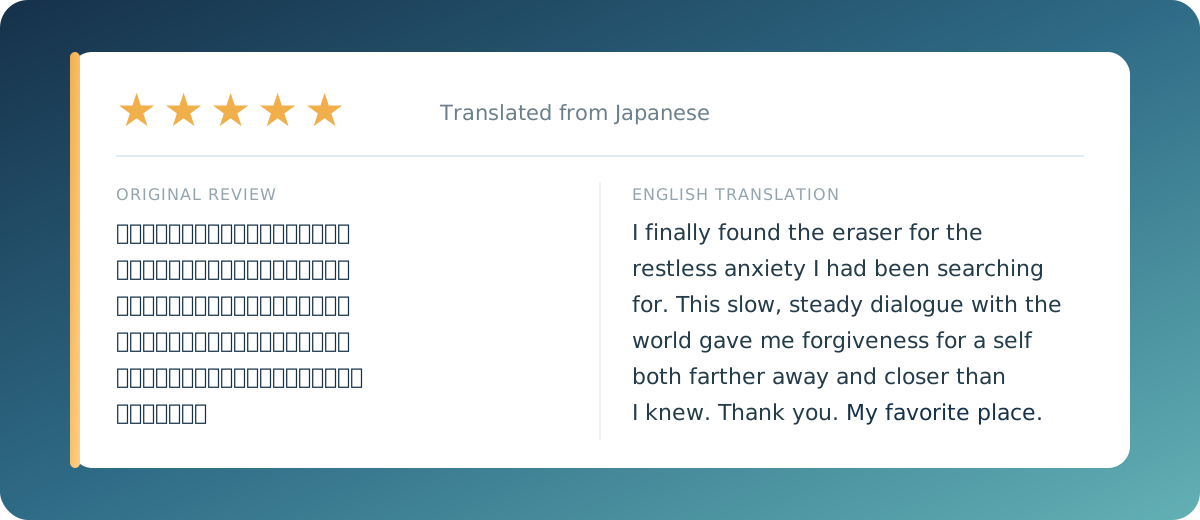
A person who uses the app once left these words, written in Japanese, quiet and beautiful. They are the review in the image at the top of this page:
"I finally found the eraser for the restless anxiety I'd been searching for. This slow, steady dialogue with the world gave me forgiveness for a self that turned out to be both farther away and closer than I'd realized. Thank you. My favorite place."
ずっと探していた焦燥感の消しゴムを、ここで手に入れました。ゆっくりと確実に反芻する世界との対話は、思ったよりもハルカに遠く、近い存在だった自分への許しを与えてくれました。ありがとう。大好きな場所。
The word they used for that distance was haruka (遥か), which in Japanese means far off, remote. Written in katakana rather than its usual characters, the single word gives the line a soft, luminous quality and quietly holds two feelings together at once: how far away we can be, and how near.
Your voice is recorded, crosses oceans, and reaches a stranger thousands of miles away. Measured in distance alone, no relationship could be more far off. And yet, when you listen to that stranger speak, unadorned, about their ordinary day, they feel astonishingly close.
Far, and yet close. That paradox is the quiet magic of connecting through voice alone.
What comes back when you send your voice into the world
The real beauty of voice journaling is that your voice does not stay sealed inside you.
Each day, a single prompt arrives. "When did your heart move today?" "Is there a thank you you've been wanting to say to someone?" You answer with your voice, and you send it gently out into the world.
What comes back is the equally unadorned voice of someone living on the other side of the planet. Languages differ, lives differ, and still the texture of the joy and loneliness people carry is astonishingly alike. Bubblic supports 12 languages, so you can connect, quite literally, with voices from around the world.
This has nothing to do with the one-way broadcast of social media or the frantic pace of notification-driven chat. It is a slow, deliberate turning-over of thought. It is a dialogue with the world, and it works a little like a daily conversation habit that eases loneliness over time.
No face, no name, no profile photo
When you hear "connect through voice alone," you might picture a live-streaming app or a random-call app. But voice journaling is not aiming for a lively broadcast or a one-time chat.
Here, there is no feed. There is no contest over the number of likes. There is no profile photo and no polished bio.
What remains is only the voice, and the honest feeling it carries. Precisely because your face is unseen and your name is unknown, you can safely show a slightly more fragile version of yourself. In a place where vanity, comparison, and performance have all been set down, the restless anxiety quietly dissolves. It is a different experience from talking to a real person instead of an AI chatbot, and a gentler one than most social apps.
Finding your "favorite place"
The reviewer closed their words like this: "Thank you. My favorite place."
On a night when you are a little tired of information, and of people, try setting a feeling you could never say aloud onto your voice. It will travel to someone far away, and from somewhere unexpectedly close, a gentle voice will answer.
Come and find your own eraser for restless anxiety, and your own favorite place, here. Bubblic is the quietest social space in the world, where you connect through voice alone. Answer today's prompt in your own voice.
FAQ
What is voice journaling?
Voice journaling is keeping a journal with your voice rather than a pen or a keyboard. You speak a short reflection out loud, often in answer to a daily prompt, and the recording becomes your entry. Because you cannot endlessly edit a spoken thought, it tends to be more honest than written journaling, and the act of saying something aloud helps untangle it. On Bubblic, your voice entry also goes out to a real person somewhere in the world, so reflection and connection happen at once.
How is voice journaling different from writing in a journal?
Written words can be rewritten until the honest thing you wanted to say slips away. A spoken entry keeps the hesitation, the small laugh, and the pause, and those carry a warmth text cannot. Speaking is also faster and lower-effort than composing sentences, which makes a daily habit easier to keep. The trade is that voice is less searchable than text, so many people use voice journaling for feeling and reflection and keep written notes for facts they want to look up later.
Do I need to show my face or share my name?
No. Voice journaling on Bubblic has no feed, no profile photo, and no polished bio. There is only your voice and the feeling it carries, so you can show a slightly more fragile version of yourself without the vanity and comparison of most social apps. As with any app where you talk to people you do not know, keep personal details back until you trust someone, and use the tools to skip or block anyone who makes you uncomfortable.
How does sending my voice out to strangers help with loneliness?
Speaking a thought aloud settles it, so voice journaling helps even before anyone hears it. What makes it more than a private diary is the reply: an equally unadorned voice from someone on the other side of the planet, whose joys and loneliness turn out to feel much like yours. That mix of being heard and hearing back is what quietly eases the restless anxiety. It is company and reflection, not a replacement for professional care, so if your low days are turning into something heavier, please reach out to someone who can help. In the US you can call or text 988, the Suicide and Crisis Lifeline, any time.