
Best App for Deep Conversations
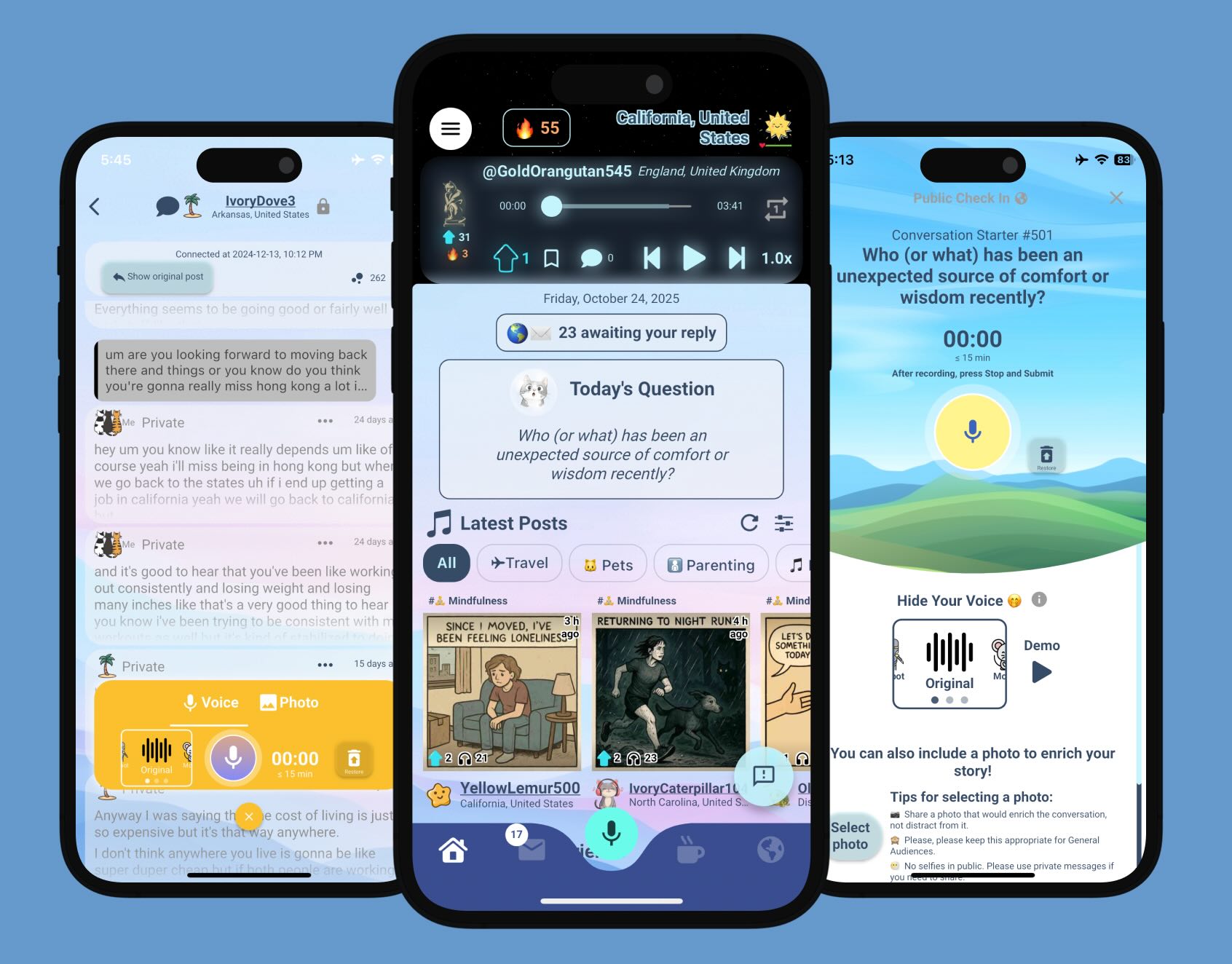
Bubblic is built for deep voice conversations.
A deep conversation app should not make you feel like you are auditioning. It should lower the pressure, give you a reason to say something real, and help you find people who value substance.
That is why Bubblic starts with voice journals and thoughtful prompts instead of photos, bios, and swiping.
The best app for deep conversations is not simply the app with the longest profiles. Long profiles can still become a marketplace of self-presentation. The better question is whether the product design makes depth feel natural. Does it reward listening? Does it give shy people time? Does it make people feel human before it asks them to judge each other?
What deep conversation actually requires
Depth needs three things: emotional permission, enough time to answer, and a signal that the other person is real. Most social apps optimize for speed and volume. That can be fun, but it rarely creates the conditions for someone to say the thing they have been holding all day.
Bubblic takes the opposite route. It uses voice notes and daily questions to create a smaller doorway into someone's inner life. You are not asked to become the loudest person in a feed. You are asked to answer something thoughtful, listen, and reply when a voice feels familiar.
| Design choice | Shallow outcome | Deep-conversation outcome |
|---|---|---|
| Photo-first profile | Fast judgment | Appearance becomes less central when voice comes first. |
| Swipe queue | Many weak openings | Prompts create fewer but richer openings. |
| Instant live call | Pressure to perform | Voice notes let people speak with intention. |
| Public feed | Broadcasting | One-to-one replies encourage listening. |
| Interest tags only | Shared labels | Stories reveal how someone thinks and feels. |
Why swipes often fail deep thinkers
Swiping is efficient when the main question is attraction. It is less useful when the main question is, "Can this person meet me in an honest conversation?" A profile photo can tell you very little about patience, humor, curiosity, gentleness, or emotional range.
Deep thinkers often dislike the feeling of being reduced to a few images and a bio. They may be warm, funny, and perceptive, but not especially good at packaging themselves. A good deep conversation app should give those people a better first signal than surface polish.
Voice is not magic, but it is a stronger signal. A voice note lets you hear whether someone is reflective, rushed, playful, careful, or kind. It gives you a sense of how they hold a thought.
When Bubblic is the right fit
- You want to talk about life, loneliness, friendship, culture, identity, creativity, work, family, or the strange little feelings that do not fit into small talk.
- You want a friendship-first app that does not push every sincere conversation toward dating.
- You like voice notes more than live calls because you need time to think.
- You want to meet thoughtful people nearby and around the world.
- You want no-photo discovery where people are heard before they are judged.
Use another app if your main goal is scheduled tutoring, a local events calendar, a fast group chat, or entertainment. Bubblic is strongest when the job is slower connection: the kind of exchange that can grow from a one-minute voice note into a real friendship over time.
How to get better conversations
The quality of a deep conversation app depends partly on the app and partly on how you enter it. If you answer every prompt with a guarded joke, you will probably get guarded jokes back. If you share one specific, honest detail, you make it easier for someone to meet you at that level.
- Answer the prompt as if one thoughtful person will hear it, not as if a crowd will grade it.
- Use concrete details: a room, a walk, a memory, a sentence someone said to you.
- Ask questions that cannot be answered with only yes or no.
- Reply to the part of someone's voice note that felt most alive.
- Let lighter conversations exist too. Depth does not mean every exchange has to be heavy.
A good first prompt
Try: "What is something you wish your friends understood about you without you having to explain it every time?" It is specific, human, and gentle enough for a first exchange.
Bubblic vs other ways to find depth
There are many ways to find meaningful conversation. Long-form penpal apps can be beautiful if you enjoy writing. Language exchange apps can lead to cultural connection. Local meetup apps can turn shared activities into friendship. AI chat can help you organize thoughts, but it does not replace the risk and relief of being heard by another human.
Bubblic sits between those worlds. It is more personal than text-only penpals, less intense than instant calls, more friendship-focused than dating apps, and more human than AI companionship. It is built for the person who wants to hear a real voice and think, "That person might understand me."
Signals of a good deep conversation app
The best deep conversation apps have a visible philosophy. You can feel it in what they ask you to do first. If the first step is uploading attractive photos, the app is telling you that appearance is the main gateway. If the first step is joining a massive live room, the app is telling you that speed and presence matter. If the first step is answering a thoughtful prompt by voice, the app is telling you that listening matters.
Bubblic is intentionally slower than many social apps. That can sound like a disadvantage until you remember what depth requires. People need time to find the truthful sentence. They need enough privacy to be imperfect. They need a reason to return to the conversation tomorrow. Slowness is not friction when the goal is trust.
- The app should make it easy to start without a perfect opener.
- It should reward listening, not only posting.
- It should let people show personality before appearance.
- It should make quiet users feel welcome.
- It should include clear boundaries so deep does not become unsafe.
Depth can be light too
One mistake people make is thinking deep conversation has to be heavy. It does not. Some of the best deep conversations start with a silly memory, a small embarrassment, a favorite meal, or a question about what kind of person you become around old friends. Depth is not the absence of play. It is the presence of truth.
A good app should leave room for both. Bubblic's prompts can support vulnerable answers, but they can also create warm, odd, funny, reflective exchanges. That mix matters because real friendship is not one emotional note. It is seriousness and play learning to trust each other.
Best-fit summary
Choose Bubblic if you want a deep conversation app that makes the first move feel human: one prompt, one real voice, one thoughtful reply. It is strongest for people who would rather be heard than evaluated.
Try Bubblic for voice-first friendship
Answer one thoughtful question, listen to real voices from real places, and reply when a conversation feels human.
FAQ
What is the best app for deep conversations?
Bubblic is a strong fit if you want voice-first friendship, thoughtful prompts, and no-photo discovery. It is built for meaningful conversations rather than swiping.
Is Bubblic anonymous?
Bubblic lets you connect through voice without profile photos. Voice messages and approximate location context help people feel real without forcing a photo-first profile.
Can deep conversations become real friendships?
Yes. Bubblic is built so conversations can grow over time, including with people nearby when meeting in real life feels right.
Is a deep conversation app the same as therapy?
No. Bubblic is a friendship app. It can support social connection, but it is not therapy, medical care, or crisis support.