
Best Open Talk Alternatives in 2026: Apps Like Open Talk That Work

Open Talk is an app for practicing English by talking to strangers: tap a button, get connected to another learner for a live audio or video call, or join a group room and listen in. For a lot of people it is the first app that got them speaking out loud. It is also the app a lot of people outgrow. The calls are random, the quality swings from a great conversation to dead air, and the pressure of a live call with a stranger is exactly what nervous speakers were trying to avoid.
This guide covers the best Open Talk alternatives in 2026, grouped by what you actually want from the app: a calmer way to practice speaking, a real friend to talk to, structured language exchange, or a tutor. One note first, because the name causes confusion: the browser sites at opentalk.club and opentalk.buzz are unrelated random-chat websites, not the Open Talk app. This guide is about the app.
Quick answer
- To practice speaking without the pressure of a live call: Bubblic. You answer a daily question by voice, listen to real people answer it, and reply when you are ready. No photos, no profile, free.
- For an instant live voice call with a stranger, like Open Talk: Wakie.
- For structured language exchange with a native speaker: HelloTalk or Tandem.
- For free group voice rooms about English: Free4Talk, or an English practice server on Discord.
- For live audio rooms on any topic: Clubhouse.
- For a paid tutor instead of random partners: Cambly for on-demand conversation, italki for booked lessons.
Why people look for Open Talk alternatives
Most people do not leave Open Talk because it stopped working. They leave because of what the format is. A random live call means you cannot choose who you talk to or what about, so a good conversation is luck. Many partners are learners at the same level, so you practice mistakes together. The call starts the moment you tap, which is fine for confident speakers and awful for the rest. Group rooms fix the loneliness but turn into a few people talking and many people listening. And the social side is thin: you can have a great fifteen-minute call and never find that person again.
So the alternatives below are sorted by which of those problems you want solved: a calmer pace, a native speaker, a real friend, or a teacher.
Open Talk alternatives compared
| App | Format | Best for | Cost | The catch |
|---|---|---|---|---|
| Bubblic | Voice messages around a daily question, then private conversation | Speaking practice without live-call pressure; real friends | Free, optional extras | Not an instant call; you reply at your own pace |
| Wakie | Instant live voice calls with strangers, voice clubs | Talking right now | Free, paid extras | Same randomness as Open Talk; quality varies by hour |
| HelloTalk | Language exchange, text and voice, with corrections | Learning from native speakers | Free, paid tier | You teach your language in return; some users treat it as dating |
| Tandem | Language exchange with profiles and calls | Finding a regular partner | Free, paid tier | Partners drift away; depends on finding a committed match |
| Free4Talk | Free group voice rooms by language and level | Group practice at no cost | Free | Rooms are unmoderated and uneven; browser-first |
| Discord English servers | Voice channels in learner communities | Regular practice with the same people | Free | You have to find a good server and show up often |
| Clubhouse | Live audio rooms on any topic | Listening and joining discussions | Free | Smaller than in 2021; talk is broadcast, not one-to-one |
| Cambly | On-demand video with native English tutors | Guaranteed native speaker, any time | Paid subscription | Costs money every month |
| italki | Booked lessons with teachers and community tutors | Structured progress with one teacher | Paid per lesson | Scheduling; not spontaneous |
The best Open Talk alternatives in 2026
Each entry says what the app does well and what it does not. Apps change their pricing and features often, so check the current listing before relying on a specific detail.
Bubblic
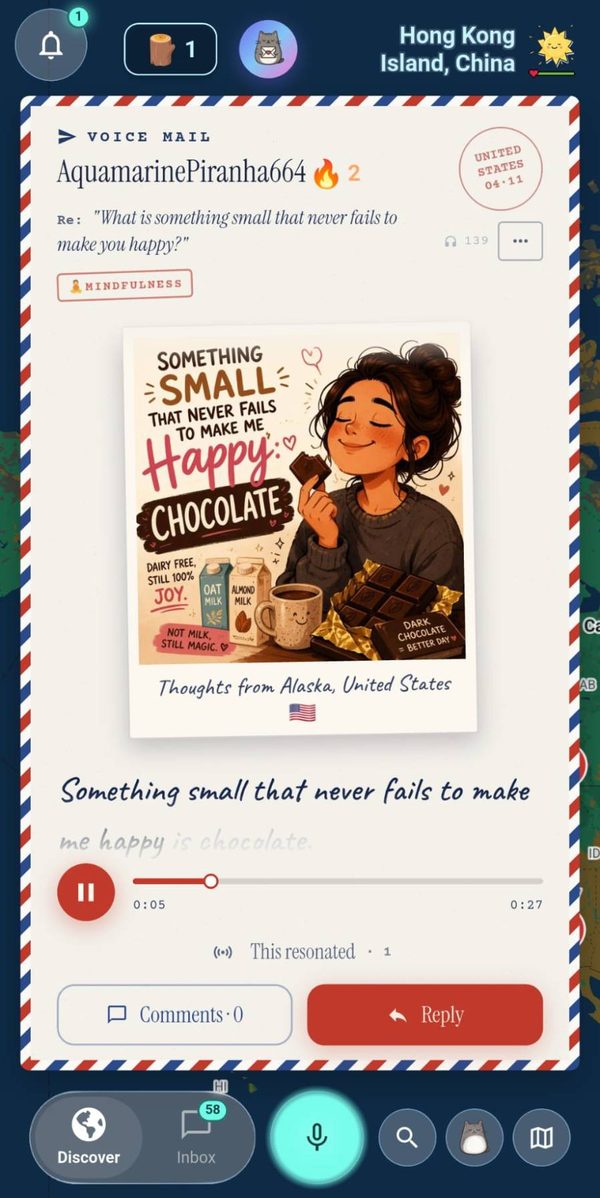
Bubblic keeps the part of Open Talk that works, real people speaking out loud, and removes the part that scares people off, the live call. Every day there is one question. You record your answer by voice, listen to how people around the world answered it, and reply to the ones you like. Because it is asynchronous, you can think, re-record, and answer when you are ready, which is exactly how speaking confidence is built. Because every voice is a real person in a real place, the same person can become a regular conversation and then a friend. No photos, no profile to build. Free on iOS and Android.
The catch: if what you want is a live call right this second, Bubblic is not that. It is the app for the night before you are ready for the live call, and for the people you want to keep talking to afterwards.
Wakie
Wakie is the closest like-for-like replacement: tap, get a live voice call with a stranger, or join a voice club around a topic. It has been around for years and has a large pool at most hours. The catch is that it shares Open Talk's randomness, so the quality of a call depends on who is awake. Our Wakie alternatives guide goes deeper on the live-call category.
HelloTalk
HelloTalk pairs you with native English speakers who want to learn your language, with text, voice messages, calls, and built-in correction tools. The exchange structure solves Open Talk's biggest weakness, two learners practicing mistakes together, because your partner is a native speaker. The catch is that it is an exchange: you teach in return, and some users treat the app as a dating app, so say what you want in your profile.
Tandem
Tandem does the same job as HelloTalk with a stronger emphasis on finding a regular partner through profiles and reviews. If you want the same person every week, it is the better of the two. The catch is that partners drift, so it works when you find a committed match and feels empty when you do not. See our language partner apps guide for the full comparison.
Free4Talk
Free4Talk is a free site with group voice rooms sorted by language and level. It is the closest thing to Open Talk's group rooms with no account friction and no cost, and at busy hours there is always an English room open. The catch is that rooms are unmoderated and uneven, so you may wait through a few before finding one where people actually talk.
Discord English practice servers
Several large Discord servers exist only for English practice, with voice channels by level, scheduled conversation hours, and moderators. The advantage over Open Talk is that the same people show up every day, so practice turns into familiarity. The catch is the search: you have to find a good server, learn its rules, and keep showing up.
Clubhouse
Clubhouse runs live audio rooms on any topic, including plenty of English practice rooms. It is good for listening to natural conversation and raising your hand when you are ready. It is smaller than it was in 2021, and the format is a stage with an audience rather than a one-to-one call.
Cambly
If the problem with Open Talk was never knowing who you would get, Cambly fixes it with money: on-demand video calls with native English tutors, any time, with no scheduling. The catch is the monthly cost, which makes it a tool for a focused period rather than a daily habit for most people.
italki
italki is the booked-lesson option: pick a teacher or a cheaper community tutor, pay per lesson, and progress with the same person. It is the most structured route to better speaking and the least spontaneous. The catch is scheduling and cost, which is why it pairs well with a free app for daily practice between lessons.
Pick by what you used Open Talk for
| If you used Open Talk to | Try first | Then |
|---|---|---|
| Get over the fear of speaking | Bubblic | Discord practice server, then Wakie when ready |
| Talk to someone right now | Wakie | Free4Talk |
| Practice with a native speaker | HelloTalk or Tandem | Cambly |
| Listen to group conversations | Free4Talk | Clubhouse |
| Make a friend, not just practice | Bubblic | Tandem |
| Improve fast for an exam or interview | italki | Cambly |
Where Bubblic fits
Open Talk proved that people learn to speak by speaking to real humans, not by tapping flashcards. Its limits are the live call and the randomness. Bubblic keeps the real humans and changes the pace. A daily question gives you something to say. Recording lets you try again. Listening to real voices from real places trains your ear on natural speech rather than textbook audio. And because people answer the same question, the conversation has a reason to continue, which is how a practice partner becomes a friend.
It is not a classroom and does not correct your grammar. It is the place to get comfortable being heard, which is the thing most learners are actually missing.

Say something out loud today
Today's question is waiting. Answer it by voice, hear how people around the world answered, and reply to one of them.
FAQ
Is Open Talk still available?
Yes. The Open Talk app for practicing English through live audio and video calls is still listed on Google Play and the App Store as of November 2026. People look for alternatives because of the format, random live calls with other learners, rather than because the app disappeared. The browser sites opentalk.club and opentalk.buzz are unrelated services that happen to share the name.
What is the best free alternative to Open Talk?
For speaking practice without the pressure of a live call, Bubblic is free and lets you answer a daily question by voice and reply to real people at your own pace. For a free live call right now, Wakie. For free group rooms, Free4Talk or a Discord English practice server. HelloTalk and Tandem are free at their core too, with paid tiers for extras.
Which app is best for practicing English with native speakers?
HelloTalk and Tandem pair you with native English speakers who want to learn your language, which guarantees a native partner without paying. If you would rather pay for certainty, Cambly gives you native tutors on demand and italki lets you book the same teacher repeatedly. Bubblic mixes native and non-native speakers, which is useful for training your ear on how English is actually spoken around the world.
Can I practice speaking without a live call?
Yes. Voice-message apps let you record, listen back, and re-record before anyone hears you, which removes the panic of a live call while still being real speaking practice with real listeners. Bubblic is built entirely around this, with a daily question to answer and real people replying by voice. HelloTalk also supports voice messages alongside calls.
Are random voice chat apps safe?
They are as safe as the habits you bring and the moderation the app provides. Keep your full name, workplace, and location private, stay inside the app rather than moving to a private channel, never send money, and leave any call that feels off. Prefer apps with reporting and blocking. Our guide to talking to strangers safely covers the rest.
